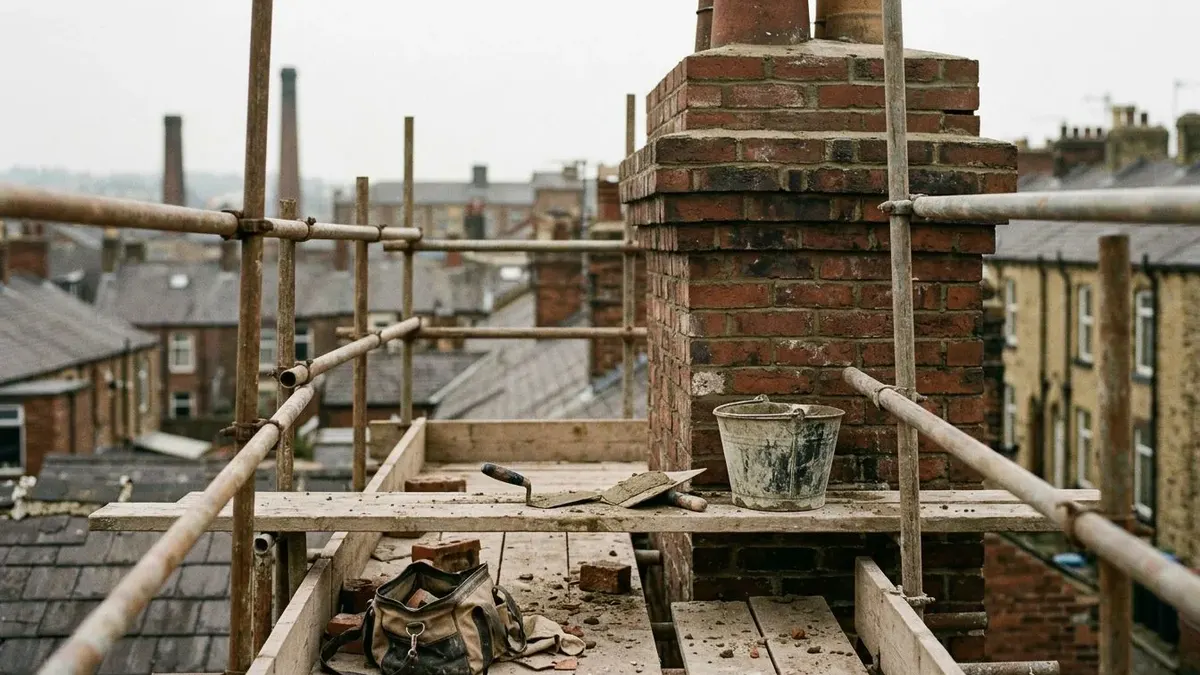
Repointing renews the mortar between sound bricks. A rebuild takes the stack down to solid brickwork and reconstructs it. The difference isn’t cosmetic, since it comes down to whether the bricks are still doing their job, or the structure has moved past the point repointing can fix.
Repointing vs rebuilding: what each actually means
Repointing removes old, crumbling mortar to a set depth and packs new mortar into the joints, without touching the bricks. It’s the routine maintenance most stacks need every few decades. Mortar weathers faster than the brick around it, since it’s designed to be the sacrificial part.
A rebuild goes further. Some or all of the stack comes down brick by brick and gets reconstructed, matching the original bond and brick where possible. It’s a bigger job because it fixes a structural problem, not a surface one. That’s the point where chimney repairs stop being routine maintenance and start being remedial work. On a taller stack, a rebuild can also mean renewing the lead flashing and crown at the same time, since it’s already exposed once the top courses come down.
Signs repointing is enough
Repointing is usually right when the bricks are firm and square-edged. The mortar has simply eroded back from the joint line. Press a fingernail into the brick face; it shouldn’t crumble. A stack that’s vertical, with no visible lean, and with damage limited to the mortar, falls into this category most of the time.
This is also the more affordable outcome. Have it assessed alongside any chimney flashing or crown issues at the same visit. Access to the top of the stack is the expensive part of either job, so it makes sense to deal with everything in one visit rather than paying for scaffolding twice in the same year.
Signs pointing to a full rebuild
Spalled brick faces can’t be repointed back to soundness. That’s where the surface has blown off, usually from frost getting into a saturated brick. The brick itself has failed here, not just the mortar. Cracks running through bricks, rather than along the joint lines, are another clear sign. So is a stack that’s visibly out of line with the roofline below it.
A cracked chimney crown that’s let water in for years often causes this kind of internal decay. The damage builds from the inside out, so it isn’t obvious until it’s advanced. By the time it shows outside, a rebuild is usually the only durable option.
Why a lean or bulge changes the answer
A stack that leans, bulges, or has visibly separated from the roofline is a different problem entirely. That’s structural movement, not weathering, and no amount of repointing corrects it. Continuing to point a leaning stack just delays a decision, and it gets more expensive the longer it waits. The same principle applies whether your roof covering is slate or tile. Either sits beneath a stack that could shed masonry in high wind.
This is exactly the kind of assessment where working at height rules matter. The Health and Safety Executive’s guidance on work at height sets out why. It needs proper access equipment and training, not a homeowner on a ladder judging a lean from the garden.
What a roofer checks before recommending either
A proper assessment starts from a scaffold or tower, not binoculars from the ground. It checks each brick face for spalling and taps for hollow-sounding sections. It also checks the stack for plumb with a level, rather than by eye. The mortar mix matters too, particularly on older properties, since the Society for the Protection of Ancient Buildings recommends assessing both the mortar type and the masonry condition first.
Make sure whoever you use also carries proper public liability insurance. A rebuild involves scaffolding over a public path or driveway, and that cover is what protects you if anything goes wrong. Ask to see the certificate rather than just taking their word for it, since it costs nothing to check and matters a great deal if a slate or brick falls during the work.
Getting a second opinion on a big job
A rebuild is expensive and irreversible, so a second opinion is worth the modest extra cost. That’s particularly true if the first quote gave no clear reason repointing wasn’t an option. Our guide on how to vet a roofer covers exactly what to ask before committing to major masonry work. Our wider guide to hiring roofing contractors near you is worth reading first. It covers what to check before you pick anyone off a search results page.
For what a proper assessment should cover, our guide on what happens in a roof survey explains a thorough inspection. It should end in a written report, not a verbal recommendation you can’t check. That report should say plainly which category your stack falls into, and why, rather than jumping straight to a price. If the wider cost of the job is a factor, our roof repair cost guide covers how prices scale with the size of the work.
Find Trusted Roofers connects homeowners with roofers in Newcastle upon Tyne and roofers in Sheffield who assess a stack properly first. Our chimney repairs page for Newcastle upon Tyne has more on what roofers there find on its older brick terraces. If you’re in Cardiff, see our Cardiff chimney repairs page. Tell us about your chimney and we’ll match you with a roofer covering your postcode.
Sources
- HSE: Work at height — why chimney assessment and repair at height is a professional job, not a DIY one.
- SPAB technical advice note: Fireplaces, Flues and Chimneys — mortar mix and masonry condition assessment for older housing stock.