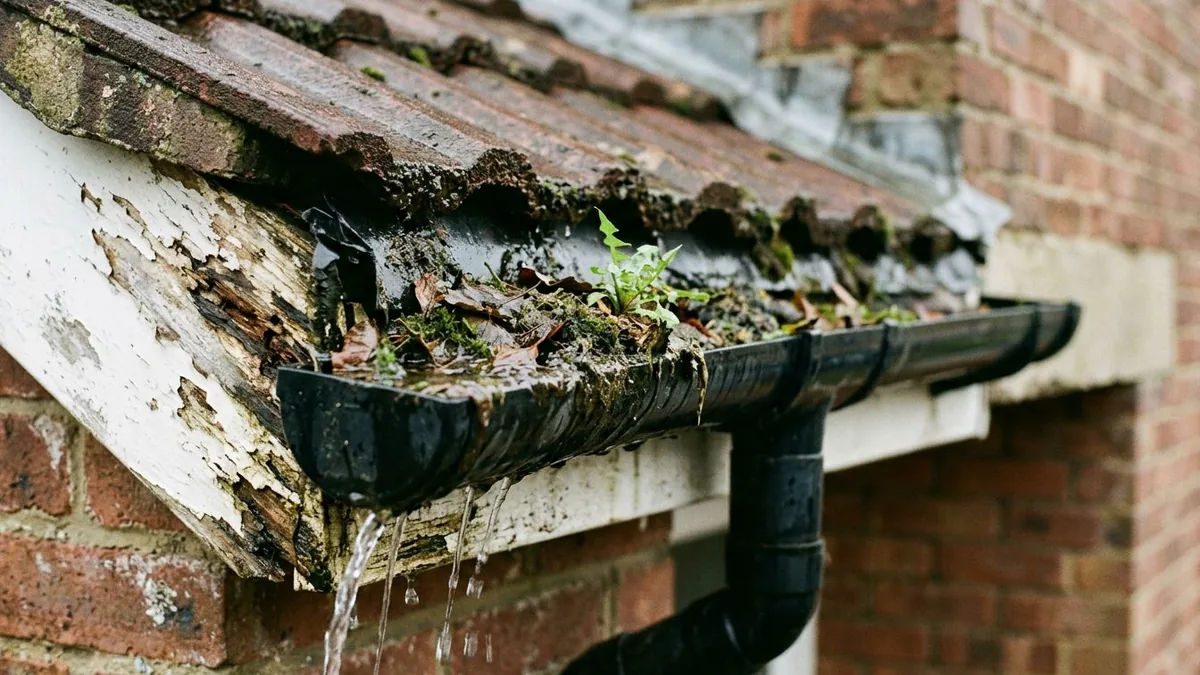
Yes. A blocked gutter doesn’t just overflow and make a mess outside. It forces water somewhere else entirely, usually the roof structure, the fascia boards, or straight into the wall below. Left long enough, it causes real, expensive damage rather than staying a cosmetic nuisance.
How a blocked gutter causes real roof damage
Guttering exists to move rainwater away from the roof edge and the walls beneath it. Once leaves, moss or debris block that path, water has nowhere to go but up and over the back of the gutter. Or it backs up under the lowest course of tiles instead of running off them. Both routes push water somewhere the roof was never designed to shed it. That’s where the damage starts.
Standing water in a blocked gutter is also heavier than most people expect. The sustained weight speeds up wear on the brackets holding the run in place. A gutter that’s been blocked for a while often ends up sagging as well as leaking. A specialist in guttering, fascias and soffits is trained to spot this before it turns into anything worse. Once a run starts to sag, the fall changes too, so water sits in new places it never used to.
Where the water actually goes instead
Once a gutter overflows, water runs straight down the outside wall instead of through a downpipe. That’s the same damp path described in our guide to a leaking roof, and it eventually shows up as a stain inside. Water forced back under the eaves tiles tracks along the roofing felt instead. It can soak the timber below, sometimes a surprising distance from the blockage itself.
On some properties, it’s the render or brickwork immediately below the gutter that suffers first. Damp patches build slowly, so they’re often mistaken for rising damp rather than an overflowing gutter above. If water has already reached inside, our guide to what a roof leak repair costs covers how that side of the job is usually diagnosed and priced.
The warning signs to check for
Look for staining or green algae streaks down the brickwork below a gutter run. Check for standing water or plant growth sitting in the gutter itself. A gutter that visibly sags between brackets is another clear sign. Inside, a damp patch at the top corner of an upstairs room, near an external wall, points to a gutter that’s been overflowing for some time.
If any of this coincides with recent storm damage, have both checked together. Heavy rain is exactly when a blocked gutter’s overflow first becomes obvious.
Fascias and soffits and timber decay
The fascia board carries the gutter, and the soffit sits underneath it. Both are timber on older properties, and both rot when repeatedly soaked by an overflowing gutter above. Once rot sets in, the fascia can no longer support the gutter brackets properly. That’s how a blocked gutter, starting as a simple maintenance job, turns into a full repair or replacement of the whole roofline.
Left further still, that same damp path often accelerates the decay covered in our guide to gutter replacement costs. A fascia has to be sound before new guttering has anything solid to fix to, which is why a roofer will usually check it first rather than quoting for guttering alone.
How often gutters should be cleared
Once a year is generally enough for most homes. Properties under or near trees need it twice a year, since that’s where blockages build up fastest. Clear gutters before autumn leaf-fall properly settles in, then again after it. That catches the two periods most likely to cause a build-up.
If gutters have gone several years without a check, don’t assume a quick clear-out is all that’s needed. Ask for gutter guards to be considered at the same time, since preventing a blockage is cheaper long-term than repeatedly clearing it. A quick look at the brackets and fall while someone’s already up there costs little extra and catches problems early.
When to call a roofer rather than clear it yourself
Clearing a ground-floor gutter from a stable stepladder is one thing. Anything higher, or any gutter you can’t safely reach, is a different matter. The Health and Safety Executive’s guidance on working at height is clear that falls from height carry a genuine risk. A blocked gutter is rarely urgent enough to justify taking that risk yourself.
A roofer will also spot problems you wouldn’t from the ground: a hairline crack, a bracket working loose, or a fascia already softening. Our guide on how to vet a roofer covers what separates a proper roofer from someone who’ll just clear the leaves and leave. Ask what they check while they’re up there, not just whether they’ll clear the leaves.
Find Trusted Roofers connects homeowners with roofers in London and roofers in Southampton who check the whole roofline, not just the visible blockage. Our London guttering page has more on what roofers in the capital typically find on older terraced housing. If you’re in Edinburgh, see our Edinburgh guttering page. Tell us about the problem and we’ll match you with a roofer covering your postcode. If you’re unsure whether the issue is the gutter or something further up the roof, our guide to roof underlay and lining explains the layer meant to catch water the gutter has missed.
Sources
- HSE: Work at height — real fall risk from clearing gutters at height, rather than presenting DIY clearance as risk-free.